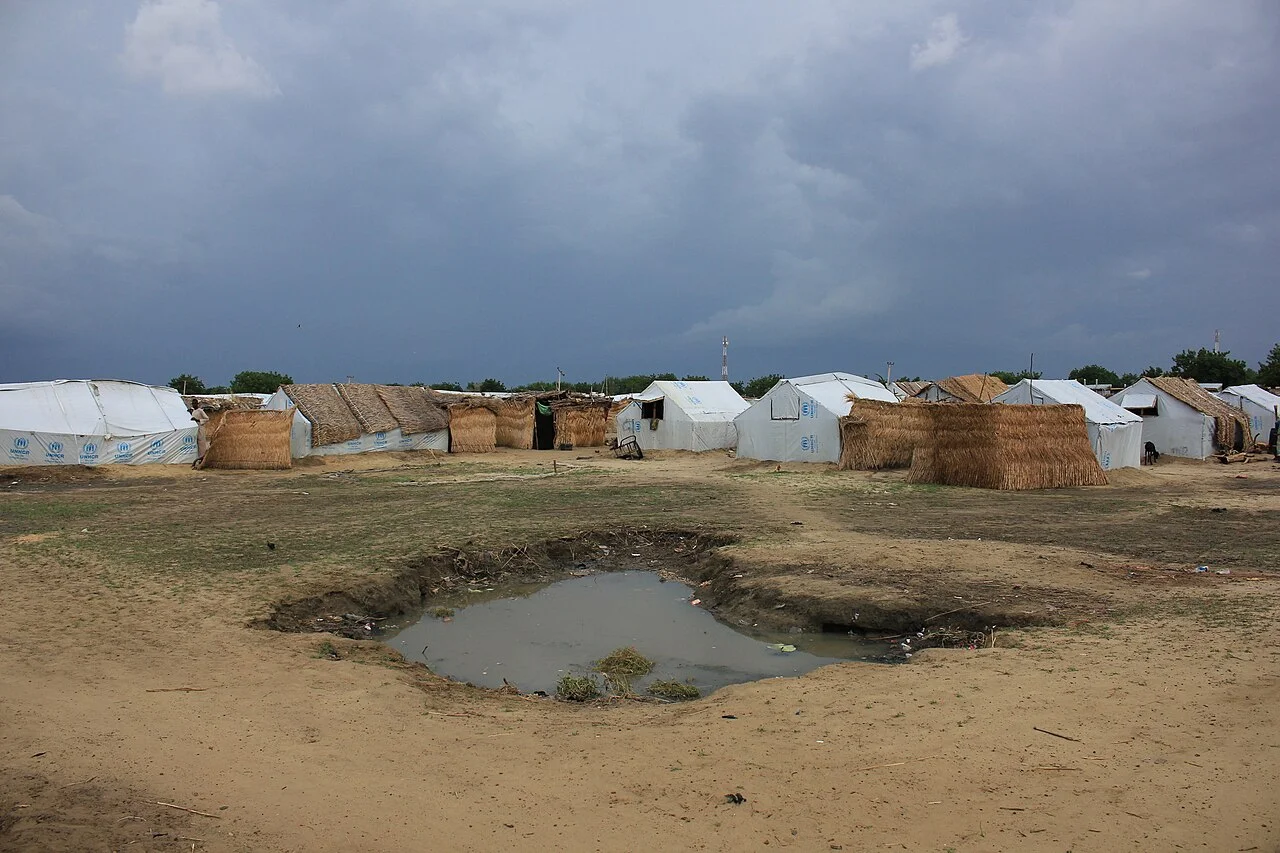
Living quarters at a camp for internally displaced people in Maiduguri, 2 August 2018. Photo: Ifeatu Nnaobi · CC BY-SA 4.0 / creditsPhotograph date: 2018-08-02
Armed violence can force people from their homes and interrupt schooling, healthcare and trade. Protection and access to services become practical tests of state authority.
Homes
Displacement changes where families can live and work.
Schools
Violence and fear can interrupt access to education.
Public authority
Security and service provision shape trust in institutions.
More & sources
Boko Haram’s armed insurgency and attacks on civilians challenged the state’s ability to provide security in northeastern Nigeria and the Lake Chad region.
Regional political competition and cross-border vulnerabilities feature in de Pontet and Sparks’s 2013 analysis of the insurgency.
Coleman and von Wendel’s 2014 analysis links attacks on schools to governance and educational exclusion.
Attacks disrupt learning, threaten pupils and teachers, and weaken access to education. In 2020, the UN called for stronger protection of schools in Nigeria.
Regional military cooperation, humanitarian assistance and action on underlying social conditions formed key parts of the UN’s 2017 Lake Chad discussion.
Military operations target armed groups; school safety, livelihoods and civilian protection support security and public trust.
UNEP’s 2011 assessment concerns contamination and restoration in Ogoniland. Oil contamination connects environmental restoration to livelihoods and public accountability.
History, institutions, resources and state responses shape political conflict. Religious and ethnic identities intersect with these conditions and with competition over representation.
More & sources
A cleavage is a socially significant division that becomes politically relevant. Ethnicity, religion, region and class may organize interests, representation or access to resources.
Identities overlap: people can share a region while differing in religion, language, community and political views.
Colonial regional administration and later constitutional choices shaped how groups sought representation. Federal arrangements are one institutional response to diversity.
Territorial representation gives groups a voice in national politics, while public services and resource distribution remain central subjects of competition.